OPERATION
|
|
|
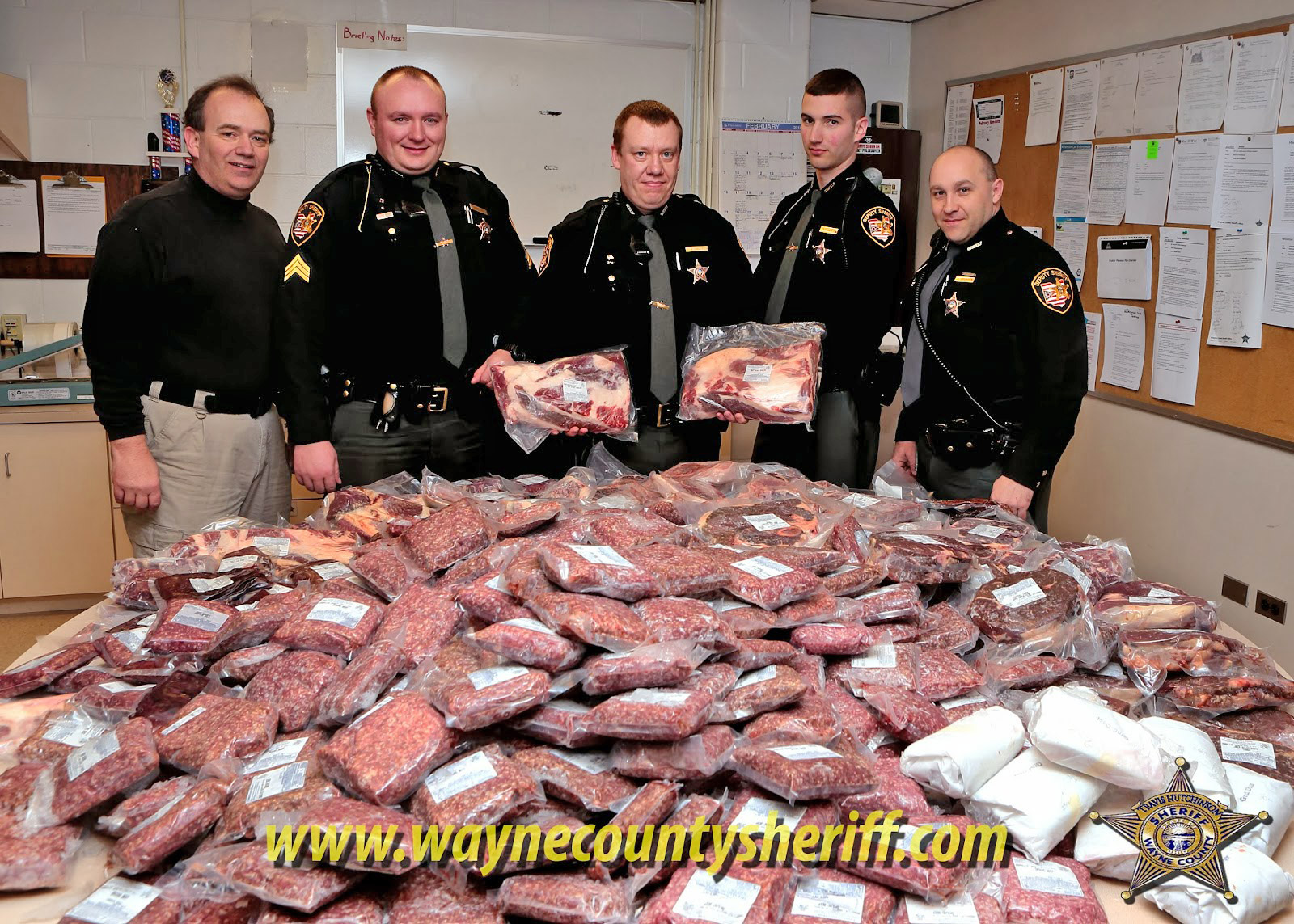
The following is from the Wayne County Sheriff’s official report:Within 15 minutes of this information being posted we received information pertaining to the suspects. Canaan Meats is a custom meat processing plant, inspected by Ohio Dept. Of Agriculture. High profile product is professionally processed and temporarily stored, and frozen, for multiple clients. Longhorns Head To Tail Store, of Barnesville, Ohio is a major client and had several tons of fresh product in storage at Canaan. Although several other clients had product stolen, the Longhorns Head to Tail inventory alone was valued at $9,015.08.
Longhorn Head to Tail Store owner, Darol Dickinson reports that all the recovered product will be disposed of, “Some seals have been broken, meat has been thawed and sanitary conditions have been compromised. The clear plastic wrapped beef is also being retained today by authorities because the suspects finger prints are on nearly every package.” Stolen product inventory included Texas Longhorn beef jerky, summer sausage, hundreds of pounds of lean grind, halves of freezer beef, quarters and assortments of primal cuts of choice grill steaks. Anyone with information on purchasers of large amounts of beef packaged in boxes labeled “Longhorns Head to Tail,” with information about this crime, please contact Wayne County Sheriff’s office at 330 287 5750. Thanks to the fast action of Wayne County Sheriff’s staff, within an hour of an all points alert on Face Book, suspects were arrested with part of two truck loads of unsold evidence — grill ready — nearly.
|
||
Operation “Where’s the Beef” Ends in Arrests
26 Feb 2014 Leave a comment




Corruption in Science? You’re Kidding!
25 Feb 2014 1 Comment
in Consolidation, Control, Disease, FDA, Food Destruction Agency, food safety, GMO's, Uncategorized, USDA
As anyone who follows the approval of FDA and USDA “science” knows, we no longer have much at all in the way of actual science. Instead we have black balling of those who don’t tote the corporate line, and science based studies that have nothing to do with legitimate science and the scientific method we are supposed to learn in school.
The following interview by Democracy Now! has clearly exposed the issue. Check it out:
Get Your Gard On! err…Garden in
19 Feb 2014 2 Comments
There has never been a time in recent history when food supplies have been more precarious than they are right now. To that end, for those in South Central Missouri and North Central Arkansas, I want to make sure you know about this event. Get all your seeds now. If your life doesn’t end up depending on them, great! They’ll keep. Please people, plant something. The more we grow, the less we are dependent upon failed consolidation and control paradigms:
| West Plains Spring Seed and Plant Swap |
| Sunday, March 9, 2014, 10:00am – 12:00pm in CDT at The Yellow House Community Arts Center, 209 Trish Knight, West Plains, Missouri 65775 |
Bring your seeds, starts, plants, and any non-toxic garden related items you would like to share to the 3rd Bi-Annual Spring Seed & Plant Swap – the first and oldest community seed swap in the Ozarks! Free and open to the public! Bookmark this page for updates, how-to’s, and other fine details. If you have questions – this is the place to ask them. See you there!
Some More Free Stuff!
19 Feb 2014 Leave a comment
As I’ve said previously, I have kind of fallen in love with the Kindle. It’s really nice to carry hundreds of books around in something the size of what used to be called a “Day Planner”. Just in case you were wondering, you’re old if you’ve heard of those, and older if you’ve used them… 🙂 Seriously though, I think it’s important to have things on paper in case of such a lovely thing as an EMP. If you’ve actually read important how to articles prior to such an occurrence, you will be well ahead. If you have them in the physical realm AND have read them, even better. If you have them electronically in a EMP hardened little case, you’ll be able to carry them with you. As long as you can find a way to charge your reader up, you’ll be something like Super Man.
Obviously, I digress.
Here are several excellent free books on things important to survival. I just wanted to share them and hope you find some of them to be useful!
Without further adieu:
http://www.amazon.com/Alternative-Medicine-Real-stories-Recipes-ebook/dp/B00I5M33JA
Food Prices Are Going to Soar
17 Feb 2014 Leave a comment
It’s always nice when you find an article covering a large amount of what you were going to be writing about and it saves you a great deal of time and energy. The following article is just exactly that. I very much appreciate this article by Michael Snyder of economiccollapse.
 By Michael Snyder, on February 16th, 2014
 Did you know that the U.S. state that produces the most vegetables is going through the worst drought it has ever experienced and that the size of the total U.S. cattle herd is now the smallest that it has been since 1951? Just the other day, a CBS News article boldly declared that “food prices soar as incomes stand still“, but the truth is that this is only just the beginning. If the drought that has been devastating farmers and ranchers out west continues, we are going to see prices for meat, fruits and vegetables soar into the stratosphere. Already, the federal government has declared portions of 11 states to be “disaster areas”, and California farmers are going to leave half a million acres sitting idle this year because of the extremely dry conditions. Sadly, experts are telling us that things are probably going to get worse before they get better (if they ever do). As you will read about below, one expert recently told National Geographic that throughout history it has been quite common for that region of North America to experience severe droughts that last for decades. In fact, one drought actually lasted for about 200 years. So there is the possibility that the drought that has begun in the state of California may not end during your entire lifetime.
This drought has gotten so bad that it is starting to get national attention. Barack Obama visited the Fresno region on Friday, and he declared that “this is going to be a very challenging situation this year, and frankly, the trend lines are such where it’s going to be a challenging situation for some time to come.”
According to NBC News, businesses across the region are shutting down, large numbers of workers are leaving to search for other work, and things are already so bad that it “calls to mind the Dust Bowl of the 1930s“…
In the state’s Central Valley — where nearly 40 percent of all jobs are tied to agriculture production and related processing — the pain has already trickled down. Businesses across a wide swath of the region have shuttered, casting countless workers adrift in a downturn that calls to mind the Dust Bowl of the 1930s.
If you will recall, there have been warnings that Dust Bowl conditions were going to return to the western half of the country for quite some time.
Now the mainstream media is finally starting to catch up.
And of course these extremely dry conditions are going to severely affect food prices. The following are 15 reasons why your food bill is going to start soaring…
#1 2013 was the driest year on record for the state of California, and 2014 has been exceptionally dry so far as well.
#2 According to the U.S. Drought Monitor, 91.6 percent of the entire state of California is experiencing “severe to exceptional drought” even as you read this article.
#3 According to CNBC, it is being projected that California farmers are going to let half a million acres of farmland sit idle this year because of the crippling drought.
#4 Celeste Cantu, the general manager for the Santa Ana Watershed Project Authority, says that this drought could have a “cataclysmic” impact on food prices…
Given that California is one of the largest agricultural regions in the world, the effects of any drought, never mind one that could last for centuries, are huge. About 80 percent of California’s freshwater supply is used for agriculture. The cost of fruits and vegetables could soar, says Cantu. “There will be cataclysmic impacts.”
#5 Mike Wade, the executive director of the California Farm Water Coalition, recently explained which crops he believes will be hit the hardest…
Hardest hit would be such annual row crops as tomatoes, broccoli, lettuce, cantaloupes, garlic, peppers and corn. Wade said consumers can also expect higher prices and reduced selection at grocery stores, particularly for products such as almonds, raisins, walnuts and olives.
#6 As I discussed in a previous article, the rest of the nation is extremely dependent on the fruits and vegetables grown in California. Just consider the following statistics regarding what percentage of our produce is grown in the state…
–99 percent of the artichokes
–44 percent of asparagus
–two-thirds of carrots
–half of bell peppers
–89 percent of cauliflower
–94 percent of broccoli
–95 percent of celery
–90 percent of the leaf lettuce
–83 percent of Romaine lettuce
–83 percent of fresh spinach
–a third of the fresh tomatoes
–86 percent of lemons
–90 percent of avocados
–84 percent of peaches
–88 percent of fresh strawberries
–97 percent of fresh plums
#7 Of course it isn’t just agriculture which will be affected by this drought. Just consider this chilling statement by Tim Quinn, the executive director of the Association of California Water Agencies…
“There are places in California that if we don’t do something about it, tens of thousands of people could turn on their water faucets and nothing would come out.”
#8 The Sierra Nevada snowpack is only about 15 percent of what it normally is. As the New York Times recently explained, this is going to be absolutely devastating for Californians when the warmer months arrive…
Experts offer dire warnings. The current drought has already eclipsed previous water crises, like the one in 1977, which a meteorologist friend, translating into language we understand as historians, likened to the “Great Depression” of droughts. Most Californians depend on the Sierra Nevada for their water supply, but the snowpack there was just 15 percent of normal in early February.
#9 The underground aquifers that so many California farmers depend upon are being drained at a staggering rate…
Pumping from aquifers is so intense that the ground in parts of the valley is sinking about a foot a year. Once aquifers compress, they can never fill with water again. It’s no surprise Tom Willey wakes every morning with a lump in his throat. When we ask which farmers will survive the summer, he responds quite simply: those who dig the deepest and pump the hardest.
#10 According to an expert interviewed by National Geographic, the current drought in the state of California could potentially last for 200 years or more as some mega-droughts in the region have done in the past…
California is experiencing its worst drought since record-keeping began in the mid 19th century, and scientists say this may be just the beginning. B. Lynn Ingram, a paleoclimatologist at the University of California at Berkeley, thinks that California needs to brace itself for a megadrought—one that could last for 200 years or more.
#11 Much of the western U.S. has been exceedingly dry for an extended period of time, and this is hurting huge numbers of farmers and ranchers all the way from Texas to the west coast…
The western United States has been in a drought that has been building for more than a decade, according to climatologist Bill Patzert of NASA’s Jet Propulsion Laboratory.
“Ranchers in the West are selling off their livestock,” Patzert said. “Farmers all over the Southwest, from Texas to Oregon, are fallowing in their fields because of a lack of water. For farmers and ranchers, this is a painful drought.”
#12 The size of the U.S. cattle herd has been shrinking for seven years in a row, and it is now the smallest that it has been since 1951. But our population has more than doubled since then.
#13 Extremely unusual weather patterns are playing havoc with crops all over the planet right now. The following is an excerpt from a recent article by Lizzie Bennett…
Peru, Venezuela, and Bolivia have experienced rainfall heavy enough to flood fields and rot crops where they stand. Volcanic eruptions in Ecuador are also creating problems due to cattle ingesting ash with their feed leading to a slow and painful death.
Parts of Australia have been in drought for years affecting cattle and agricultural production.
Rice production in China has been affected by record low temperatures.
Large parts of the UK are underwater, and much of that water is sea water which is poisoning the soil. So wet is the UK that groundwater is so high it is actually coming out of the ground and adding to the water from rivers and the sea. With the official assessment being that groundwater flooding will continue until MAY, and that’s if it doesn’t rain again between now and then. The River Thames is 65 feet higher than normal in some areas, flooding town after town as it heads to the sea.
#14 As food prices rise, our incomes are staying about the same. The following is from a CBS News article entitled “Food prices soar as incomes stand still“…
While the government says prices are up 6.4 percent since 2011, chicken is up 18.4 percent, ground beef is up 16.8 percent and bacon has skyrocketed up 22.8 percent, making it a holiday when it’s on sale.
#15 As I have written about previously, median household income has fallen for five years in a row. So average Americans are going to have to make their food budgets stretch more than they ever have before as this drought drags on.
If the drought does continue to get worse, small agricultural towns all over California are going to die off.
For instance, consider what is already happening to the little town of Mendota…
The farms in and around Mendota are dying of thirst. The signs are everywhere. Orchards with trees lying on their sides, as if shot. Former farm fields given over to tumbleweeds. Land and cattle for sale, cheap.
Large numbers of agricultural workers continue to hang on, hoping that somehow there will be enough work for them. But as Evelyn Nieves recently observed, panic is starting to set in…
Off-season, by mid-February, idled workers are clearly anxious. Farmworkers and everyone else who waits out the winter for work (truckers, diesel providers, packing suppliers and the like) are nearing the end of the savings they squirrel away during the season. The season starts again in March, April at the latest, but no one knows who will get work when the season begins, or how much.
People are scared, panicked even.
I did not write this article so that you would panic.
Yes, incredibly hard times are coming. If you will recall, the 1930s were also a time when the United States experienced extraordinarily dry weather conditions and a tremendous amount of financial turmoil. We could very well be entering a similar time period.
Worrying about this drought is not going to change anything. Instead of worrying, we should all be doing what we can to store some things up while food is still relatively cheap. Our grandparents and our great-grandparents that lived during the days of the Great Depression knew the wisdom of having a well-stocked food pantry, and it would be wise to follow their examples.
Please share this article with as many people as you can. The United States has never faced anything like this during most of our lifetimes. We need to shake people out of their “normalcy bias” and get them to understand that big changes are coming.

Thinking Outside the Box Gets You an Eviction Notice
14 Feb 2014 Leave a comment
Florida City Evicts Widow Robin Speronis For Living Off The Grid (Video)

After a Florida woman appeared on the local news to talk about her alternative lifestyle living off the grid – without electricity or running water – she received an eviction notice from the City of Cape Coral.
City officials say Robin Speronis’ house violates international property maintenance code, claiming the property is unsafe to live in.
Speronis questions how the code enforcement officer could know that having never set foot inside her house.
“A code enforcement officer came, knocked on the door then posts a placard that says uninhabitable property, do not enter,” Speronis told WFTX-TV.
“Putting a woman who lives by herself, who is a widow, out on the street without any due process of law is unfathomable,” she added.
“Sounds like the city feels that this is an unsanitary situation,” said WFTX reporter Lisa Fernandez.
“How would they know?” Speronis asked. “They have never been inside.”
The city code compliance manager told Fernandez that the home was tagged because it has no running water or electricity, but neither are part of the code cited by the city on the notice.
“Where is the justice? Why did they choose me,” she asked, “I was exercising my First Amendment rights of free speech in discussing living off the grid.”
An attorney offered to take Robin’s case pro bono.
“I’m going to bring this to the attention of anyone who will listen until justice is served,” she said.
Cape Coral told the TV station that if Speronis can prove she can sustain her life and the home without running water or electricity, they that may be able to come to an agreement.
OSLU Disaster Preparedness Seminar January 18th
14 Jan 2014 Leave a comment
Disaster Preparedness Seminar Jan 18
Fun and Friends Senior Center in Thayer
9 am to 5 pm Saturday, January 18
OSLU – Ozarks Self Reliant Living University
Survive and thrive through ice storms, tornadoes, earthquakes, terrorist attacks and other disasters.
SPEAKERS
- Bryan Haas of Ozark Mountain Self Reliance on Prepping 101 and what to put in a bug out bag
- John Price of the West Plains HAM Radio Club on radio communication during emergencies
- Dave Lohr of Kosh Trading Post will demonstrate survival techniques in primitive conditions, including how to make your own bow and arrows, how to trap small game and survive without shelter
- Wayne Simmons, an Oregon County Ambulance paramedic on Emergency Medical Care When No Doctor is Available
- Bob Anderson, author of the bestselling Survivalist novels and a 30 year Air Force Military Police veteran on Organizing Your Community
- Mike Evans, radio talk show host on Restoring Freedom in America.
ü Seminar is totally free.
ü Lunch is available for $4 including drinks and deserts.
ü Everyone attending will be able to visit one-on-one with the experts.
For more information
or to RSVP
call 417-264-2435
SCOTUS Won’t Hear Monsanto Terrorism Case
14 Jan 2014 Leave a comment
Monsanto Escapes US Supreme Court Hearing on Seed Patents
The U.S. Supreme Court on Monday upheld Monsanto’s biotech seed patents, dealing a blow to Organic Seed Growers and Trade Association (OSGATA) who were attempting to ward off lawsuits by the company against farmers.

OSGATA, made up of 83 organic and conventional family farmers, seed companies and public advocacy interests, sued Monsanto in March 2011 seeking to prohibit the company from suing them if their fields became inadvertently contaminated with its patented genetic traits for corn, soybeans, cotton, canola and other crops.
The specialty seeds are genetically engineered to withstand dousings of glyphosate, the main ingredient in Monsanto’s Roundup herbicide.
“The Supreme Court failed to grasp the extreme predicament family farmers find themselves in,” said Maine organic seed farmer Jim Gerritsen, President of OSGATA. “The Court of Appeals agreed our case had merit. However, the safeguards they ordered are insufficient to protect our farms and our families. This high court which gave corporations the ability to patent life forms in 1980, and under Citizens United in 2010 gave corporations the power to buy their way to election victories, has now in 2014 denied farmers the basic right of protecting themselves from the notorious patent bully Monsanto.”
“The Appellate Court decision could leave Canadian farmers out in the cold because their protection may not extend to Canada at all,” said Saskatchewan organic grain farmer Arnold Taylor, a member of plaintiff member Canadian Organic Growers (COG). “Like many Canadian farmers, we sell crop into the United States and can therefore be liable to claims of patent infringement by Monsanto.”
OSGATA asked Monsanto for a pledge not to sue, but the company refused, saying: “A blanket covenant not to sue any present or future member of petitioners’ organizations would enable virtually anyone to commit intentional infringement.”
The biotech crops are widely used throughout the United States. Monsanto has sued more than 100 farmers for patent infringement, winning judgments against those found to have made use of its seed without paying required royalties.
OSGATA lost the case in the district court and in the U.S. Court of Appeals for the Federal Circuit.
“Monsanto never has and has committed it never will sue if our patented seed or traits are found in a farmer’s field as a result of inadvertent means,” said Kyle McClain, the company’s chief litigation counsel.
“The lower courts agreed there was no controversy between the parties,” McClain added, “and the Supreme Court’s decision not to review the case brings closure on this matter.”
Blogger’s Incarceration Raises First Amendment Questions
12 Jan 2014 1 Comment
This is pretty frightening. While the blogger in question might very well be untruthful, rude, defaming people’s character, and certainly vindictive and inflaming, imprisoning him is an even more dangerous precedent. It should scare the pants off of anyone that is an advocate of free speech. While we might detest things that some people say, their right to show themselves as being fools is something that we should all cherish. Thoughts on this article would be deeply appreciated.
Blogger’s Incarceration Raises First Amendment Questions
By CAMPBELL ROBERTSONJAN. 11, 2014
BIRMINGHAM, Ala. — For over six years, Roger Shuler has hounded figures of the state legal and political establishment on his blog, Legal Schnauzer, a hothouse of furious but often fuzzily sourced allegations of deep corruption and wide-ranging conspiracy. Some of these allegations he has tested in court, having sued his neighbor, his neighbor’s lawyer, his former employer, the Police Department, the Sheriff’s Department, the Alabama State Bar and two county circuit judges, among others. Mostly, he has lost.
But even those who longed for his muzzling, and there are many, did not see it coming like this: with Mr. Shuler sitting in jail indefinitely, and now on the list of imprisoned journalists worldwide kept by the Committee to Protect Journalists. There, in the company of jailed reporters in China, Iran and Egypt, is Mr. Shuler, the only person on the list in the Western Hemisphere.
A former sports reporter and a former employee in a university’s publications department, Mr. Shuler, 57, was arrested in late October on a contempt charge in connection with a defamation lawsuit filed by the son of a former governor. The circumstances surrounding that arrest, including a judge’s order that many legal experts described as unconstitutional and behavior by Mr. Shuler that some of the same experts described as self-defeating posturing, have made for an exceptionally messy test of constitutional law.

“You’ve got a situation where sometimes there’s no good guys,” said Ken White, a former federal prosecutor in Los Angeles who writes about and practices First Amendment law.
Mr. Shuler is no stranger to defamation suits, as one might surmise from reading his blog. He started it in 2007 to document a property dispute with his neighbor that blew up into a legal war and ended with the neighbor’s lawyer becoming a part-owner of Mr. Shuler’s house, which is in Birmingham. Later, the blog branched out to expose what he alleged were the corrupt machinations of powerful figures, mostly Republicans, and with a particular animus toward former Gov. Bob Riley.
His allegations are frequently salacious, including a recent assertion that a federal judge had appeared in a gay pornographic magazine and a theory that several suicides were actually a string of politically motivated murders. Starting in January 2013, Mr. Shuler, citing unidentified sources, began writing that Robert Riley Jr., the son of the former governor, had impregnated a lobbyist named Liberty Duke and secretly paid for an abortion. Both denied it, and Ms. Duke swore in an affidavit that they had never even been alone in the same room.
In July, Mr. Riley and Ms. Duke sought an injunction in state court against such posts, citing Mr. Shuler and his wife, Carol, in defamation suits. A judge issued a temporary restraining order in September barring the Shulers from publishing “any defamatory statement” about Mr. Riley and Ms. Duke and demanding that the offending posts be immediately removed.
Such a sweeping order struck some lawyers as far too broad, and Mr. Shuler says he did not even know about it.
The Shulers refused to answer the door when officials came to serve court papers, stating their suspicions in blog posts that the visits were part of an “intimidation and harassment campaign” stemming from the reporting on another topic.
One afternoon as the Shulers drove to the local library, where Mr. Shuler had been writing his blog since they could no longer pay for their Internet connection, a member of the Sheriff’s Department pulled them over, saying they had run a stop sign. The officer then served them the papers, which the Shulers refused to accept, contending that service under such a pretext was improper.
“We were both throwing the papers out of the windows as we were driving off,” Ms. Shuler said in an interview.

The Shulers missed a hearing the next day, and the restraining order was superseded by a similarly worded preliminary injunction, which some free-speech advocates saw as a clear violation of Mr. Shuler’s First Amendment rights.
“It seems to me that the judge’s order was really way out of bounds,” said David Gespass, a civil rights lawyer in Birmingham, who was further troubled by the judge’s initial decision to keep the case under seal.

Mr. Shuler continued blogging. On Oct. 23, the police followed Mr. Shuler as he pulled into his driveway, arrested him in his garage and took him to jail on charges of contempt and resisting arrest.
In the hyperpartisan corners of the blogosphere where Mr. Shuler was already known, there was shock. Even some of his dedicated foes were alarmed.
The National Bloggers Club, a group led by the Republican activist Ali Akbar, who has also threatened to sue Mr. Shuler for defamation, released a statement condemning Mr. Shuler’s “rumormonger cyberbullying” but also criticizing the injunction as creating a potential chilling effect on blogging.
The state chapter of the American Civil Liberties Union filed a “friend of the court” brief, and the Reporters Committee for Freedom of the Press sent a letter to the judge.
On Nov. 14, the judge held a hearing, and Mr. Shuler, who was representing himself, took the stand, insisting that the court had no jurisdiction over him and calling the court a joke. The judge decided that the hearing had “served as a trial on the merits” and made his final ruling: Mr. Shuler was forbidden to publish anything about Mr. Riley or Ms. Duke involving an affair, an abortion or payoffs; was to pay them nearly $34,000 for legal fees; and was to remove the offending posts or remain in jail.
Mr. Riley said Mr. Shuler’s refusal to engage with the legal process had given the judge the leeway to make a final ruling.
“If someone can continually ignore the judge just by saying, ‘You don’t have jurisdiction over me,’ then the whole system breaks down,” Mr. Riley said, adding that Mr. Shuler could not plead ignorance of the legal process. “This is not the first time Roger Shuler has been in court.”
But Mr. White and others say that before a judge can take the step of banning speech, libel must be proved at trial, or at least over a litigation process more involved than a quick succession of hearings, with the only evidence presented by the plaintiffs.
“Idiocy is not a zero-sum game,” Mr. White said. “I think you can say that what the court is doing is unconstitutional and troublesome and also that Shuler is his own worst enemy.”
So while the furor has all but dissipated, Mr. Shuler remains in jail, unwilling to take down his posts but also unwilling to hire a lawyer and contest his incarceration in the state courts.
“This is flat-out court corruption, and it’s criminal,” he said in an interview from prison.
His wife spoke of collecting damages when this is over, but Mr. Shuler is thinking beyond civil remedies this time: He is planning to bring federal criminal charges against the judge.
The Food Industry Bill to Avoid GMO Labeling
10 Jan 2014 Leave a comment
We knew this would be coming. As far as I know, they have yet to get a sponsor for this bill, but this exactly what they want. To preempt all labeling efforts that will allow people to know whether or not a food product may contain GMO’s.
I received this information from the Organic Consumers Association. I have no reason to doubt that this is truthful as it fits the MO of the corporate control paradigm we are in. I think that it is highly likely to receive great support from the Monsanto funded representatives we have. Roy Blunt of Missouri being among my chief suspects to push this bill.
It’s terribly difficult for me to encourage anyone to call the federal government for any reason as it almost always is an exercise in futility. Perhaps if enough calls were made to the offices of likely sponsors this could gain traction to make it socially unacceptable to sponsor this bill. Reluctantly, I think that may be the thing to do right now.
Natural would allow GMO’s, additives that are GMO would not be required to be labeled….and more. It’s terribly typical.
Here is the copy of the bill:
Section by Section Summary of Discussion Draft
Overview
This legislation would create a uniform, national program governing the premarket review and labeling of genetically engineered foods. First, it would require the Food and Drug Administration (FDA) to conduct a safety review of all new plant varieties used for genetically engineered food before those foods are introduced into commerce. Second, the legislation would create a new legal framework, subject to FDA oversight, governing the use of label claims regarding either the absence of, or use of, genetically engineered food or food ingredients. The legislation would also require FDA to develop Federal definition for “natural” claims on product labels. Given this new legal framework, states would be precluded from imposing any requirements that are not identical to these Federal requirements.
TITLE 1-Bioengineered Food
Section 101. Definitions.
The term “bioengineered food” is defined to mean a food developed through recombinant deoxyribonucleic acid (DNA) technology. A food is not a bioengineered processing aid or enzyme. The terms “bioengineering” or “bioengineered” are defined to mean the process described above as applied to food.
Section 102. Notification Program for Preclearance of Bioengineered Food that is a Plant or Derived from a Plant.
This provision would add a new section to the Federal Food, Drug, and Cosmetic Act (FFDCA) creating a mandatory premarket notification program for bioengineered foods, It would require that a developer of a plant-based bioengineered food submit a premarket notification to the FDA before marketing the food, explaining the developer’s basis for determining the bioengineered food was as safe as a comparable traditional food. Premarket notification must be submitted 120 days before bioengineered food is delivered into the marketplace. Those bioengineered foods that were approved through the voluntary consultation process prior to this legislation being enacted would be grandfathered in. The bill would also provide for informal consultations with the Secretary prior to submitting a premarket notification. The mandatory consultation process would be as follows: within 30 days, FDA would be required to issue a preliminary response in writing to notify the developer that 1) the notification is complete and has been filed or 2) the notification is incomplete and specify the additional information required prior to filing. The FDA would have 90 days to review the notification and state whether the agency objects to the developer’s determination. The FDA also would have the option to extend the review period by 90 days, not more than once. The developer would have the option to withdraw the notification at any time prior to a determination by FDA. If FDA responds it has no objections, the developer may market the food.
As part of the review process, FDA may specify any special labeling the agency believes is necessary to protect the health and safety or to prevent the label of the bioengineered food from being false or misleading, based on any material difference between the bioengineered food and the comparable traditional food. The use of bioengineering does not, by itself, constitute a material difference.
The premarket notification and the agency’s response would be made publicly available. The Secretary may issue any regulations or guidance that may be necessary to implement this program. The provisions of this section would apply 30 days after enactment, regardless of whether regulations and guidance have been issues. These procedures would largely codify a preexisting voluntary consultation process currently used by FDA
Section 103. Labeling of Whether Food is Bioengineered
This section would create a new Federal legal framework for labeling related to bioengineered foods. It would allow manufacturers to voluntarily make claims about the absence of bioengineered ingredients if the manufacturer has in place a traceability program to ensure bioengineered food is not commingled with the non-bioengineered food at any stage of production from farm to retail, while making allowances for unavoidable, inadvertent cross contact with bioengineered foods. The claim could be made on dairy products derived from cows and other milk-producing animals that consumed feed or a feed ingredient or received a drug or biological product that was developed through biotechnology and has been authorized for such use by the Secretary. The claim may also be made on a food produced with a bioengineered processing aid or enzyme. To avoid misleading consumers, claims regarding bioengineering would not be permitted to state or imply that a food is more or less safe solely because of the use or absence of bioengineered food. The provision would also authorize FDA to develop regulations for the voluntary labeling of the presence of bioengineered ingredients in food products. As under the mandatory notification program, FDA would have the authority to mandate special labeling to address any material difference that could affect health and safety or cause consumer deception. The regulations under this section shall not prevent a person from a) disclosing voluntarily on the labeling of bioengineered food the manner in which the food has been modified to express traits or characteristics that differ from its comparable marketed food or 2) from disclosing advertisements, on the internet, in response to consumer inquiries, or on other communications that food is or contains an ingredient derived through the use of biotechnology.
Section 104. Preemption.
Consistent with other labeling sections in this FFDCA, this section would preempt any state laws that are not identical to the Federal program.
Title II-Natural Foods
Section 201. Labeling of Natural Foods
This section would direct FDA to develop a federal definition of the term “natural” for use on food packaging. This definition would apply to those foods labeled “100% natural,” “naturally grown,” “all natural,” “contains ‘no artificial ingredients,’ “nothing artificial,” and other terms identified/defined by the Secretary.
Section 202. Regulations
Within 12 months of the date of enactment of the legislation, the Secretary would issues proposed regulations to implement this section and a final rule would be issues within 36 months.
Section 203. Preemption Consistent with other labeling sections in this FFDCA, this would prevent any state definitions of the term “natural” that are not identical to the Federal definition.
Ensuring Safe and Affordable Food for American Families
The American food industry has led the world in healthy and Plentiful food production for generations. Over the last two decades, the food industry has used genetically modified (GM) technology to produce more nutritious food at lower cost for consumers across the country. GM technology improves crops and reduces the use of chemicals, while lowering costs for the American people by as much as 30%. Today, up to 80% of the nation’s food products include GM ingredients.
The American food industry is committed to providing consumers with choices to fit their tastes, dietary preferences and requirements and budgets, as well as with important information to help make those choices. The U.S. Food and Drug Administration (FDA) currently sets national standards for food labeling based on sound science and extensive review. Some groups are attempting to create a system of conflicting state-based labeling requirements for GM foods, which would create confusion, reduce choices and increase costs for consumers.
When it comes to genetically modified food ingredients, the food and beverage industry is;
1) Committed to provide consumers with an abundant supply of safe, nutritious and affordable food.
2) Committed to the use of safe agricultural biotechnology that helps feed billions of people in the u.S. and around the globe, while preserving our natural resources.
3) Committed to an open dialogue with consumers about GM technology that will advance their knowledge, understanding and support of technology.
4) Committed to responsible nationwide public policies that will protect consumers and facilitate informed consumer choices by providing them a single, federal framework for regulating the use and labeling of genetically modified food ingredients.
Healthier Foods at Lower Cost
For nearly twenty years, farmers and food manufacturers have used GM technology to add desirable traits from one plant to another, without introducing anything unnatural or using chemicals. As a result crops are more plentiful and potentially more nutritious.
Today nearly 80% of the food we eat is produced with GM ingredients, lowering costs for consumers up to 30%. These technological advances allow farmers and food and beverage companies to continue to provide consumers with safe, cost-effective and high quality food choices.
According to the U.S. food and Drug Administration (FDA), and a number of US regulatory agencies that study and monitor food safety, GM foods and ingredients are safe and pose no health risks, Numerous scientific bodies and health groups, such as the World Health Organization, the American Medical Association and the National Academy of Science, have concluded that food and beverages containing GM ingredients are materially no different than food without them.
Protecting Consumers’ Health and Safety: Building on the Strong Foundation
Consumers should be armed with the information they need to make their own food choices. That’s why the U.S. Food and Drug Administration (FDA) currently provides comprehensive federal framework for food labeling that uses sound science to give consumers the best information about the safety, composition and nutritional aspects of food products. This labeling policy has served consumers well by providing them with straitforward and meaningful information to make safe and healthful food choices.
Currently, FDA does not require foods to be labeled as having been produced with GM technology because it has found that there is no health risk associated with GM foods or any material difference between GM and non-GM foods at all. However, over the past several years, some groups have put forward ballot initiatives and legislation to require special labels for products containing these ingredients. Last year, California voters rejected a ballot measure (Proposition 37) that would have imposed a mandatory label. Voters in Washington will consider a similar measure this year, and efforts are underway to put a labeling measure on the ballot in Oregon in 2014. Connecticut recently passed Labeling Legislation, and efforts are being considered in neighboring state.
These state-based labeling initiatives – which only mislead consumers into thinking foods produced using GM technology pose a health risk or are different than what;s been on their shelves for the past 20 years – would create an unnecessary state patchwork of conflicting labeling requirements which would snarl inter-state commerce and create confusion, reduce choices and increase costs for consumers.
Bolstering Consumer Confidence in the Food Supply by Establishing a New, Single Federal Framework for Regulating the Use and Labeling of GM Technology
To establish a responsible federal policy framework that will protect consumers and facilitate informed consumer choices, as well as guard against costly, unnecessary and inefficient state-by-state system, federal legislation is needed that will provide for a series of regulatory measures that will allow farmers, processors, food and beverage manufacturers and everyone in between to use GM technology to produce safe, abundant and affordable food.
Specifically, legislation is needed that would address the following principles:
- Mandate FDA Safety Reviews: Ensure consumers are protected by requiring the U.S. Food and Drug Administration (FDA) to conduct a pre-market safety review of all new GM technology to guarantee they are safe for use in food. This will be done through FDA mandatory consultations in the existing USDA framework.
- Require Federal GMO Labeling for Safety: Directs FDA to mandate a label on any product that contains ingredients derived from genetically engineered plants if those ingredients present any health or safety risk.
- Create a National Standard for Voluntary Labels: The legislation should direct the FDA to mandate labels on products containing a GMO ingredient only if it is determined that the ingredients presents a health or safety risk. In addition, the legislation should direct FDA to develop a new, uniform national framework to support a voluntary “GMO-Free” labeling. FDA would develop a certification and verification process to support this requirement, which would also apply to any companies that want to voluntarily label their products for the presence of GM ingredients.
This will ensure consumers have consistent information that will allow them to make informed decisions when they shop, and it will prevent confusion that can be caused b conflicting state standards.
- Increase Transparency: Increase transparency and avoid consumer confusion by creating a consistent federal definition for “natural” claims on product labels.
- Prevent Consumer Confusion: Prevent consumer confusion that would be caused by conflicting state standards, and better protect consumers by creating a new uniform national legal framework. This will ensure consumers receive consistent information based on sound science by precluding state from imposing any labeling requirements that are not identical to Federal requirements standardsi




 Truth Farmer
You must be logged in to post a comment.